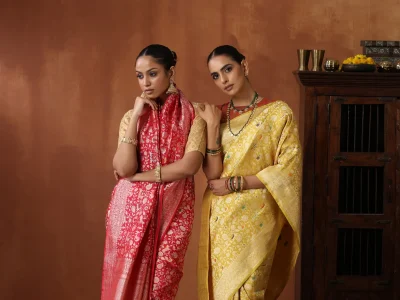
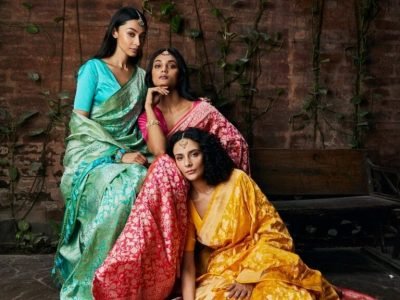
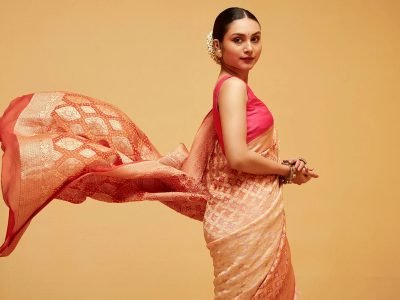
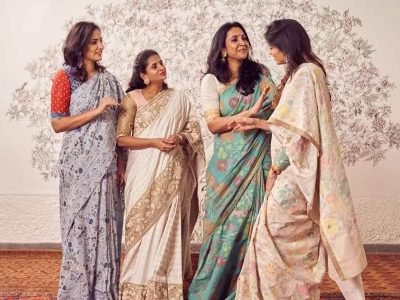
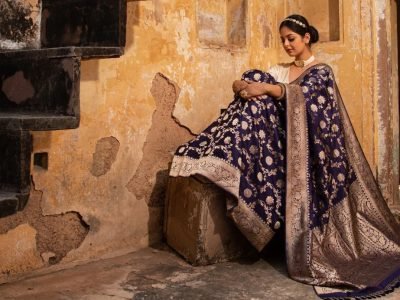
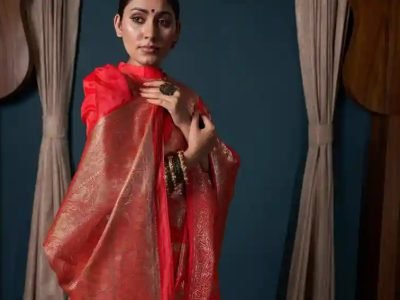
There’s a different kind of silence when you unfold a vintage saree. It’s not just fabric that comes alive—it’s a moment, a fragrance, a whisper of laughter from another room, another decade. These heirloom sarees, tucked away in old trunks, folded with care and reverence, carry more than thread and dye. They carry the echo of women who wore them before us—their strength, their style, their stories. And today, as we revive them, we’re not just bringing a piece of cloth back to life. We’re continuing a lineage of grace.
Heirloom sarees often arrive in our lives like secrets waiting to be rediscovered. Maybe it’s a Kanjeevaram your grandmother wore for her wedding. Or a Bengal taant your mother saved for Diwali. Sometimes it’s a Banarasi with worn-out zari, or a faded Bandhani that still smells faintly of sandalwood and summers long past. And in that moment when you run your fingers over its weave, you begin to understand that revival isn’t just about aesthetics. It’s about listening. About honoring.
Reviving these old sarees is a gentle act of preservation. Sometimes all they need is a careful wash, a new fall, a fresh blouse. Other times, they need mending—stitches along fraying edges, darning where time has thinned the silk. And in doing that work, there’s an intimacy that grows. You aren’t just fixing a fabric. You’re rescuing a memory. Every patch, every repair becomes a mark of love, of effort, of choosing continuity over convenience.
There’s also a quiet rebellion in wearing vintage today. In a world rushing toward the new, the now, the next trend, choosing something that’s decades old is radical. It says, I don’t need more—I already have beauty in my hands. It reminds us that craftsmanship is timeless, that what was made with patience will always outlive what was made for speed. These sarees are not just beautiful—they are sustainable, soulful, and saturated with meaning. And when you wear one, you carry that depth with you, visibly.
Styling an heirloom saree today doesn’t have to mean recreating the past. It can mean mixing the old with the modern. Pairing that rich Kanjeevaram with a contemporary crop top, or layering a traditional Kota with leather boots and a trench. It’s about giving old weaves new energy. It’s about celebrating their age without being bound by it. The saree, after all, has always evolved—not by changing its essence, but by changing with its wearer.
There’s something unspeakably powerful about looking into a mirror and seeing your grandmother’s saree draped on your body. It’s like meeting her for the first time again. It’s wearing her strength. Her choices. Her dignity. And at the same time, it’s also you—your styling, your movement, your present. The saree becomes a dialogue between generations. A thread that connects women across time, not through words, but through the very feel of cloth over shoulder and waist.
Even the act of passing down a saree has ritual to it. When an older woman chooses to gift one of her prized weaves to someone younger, it’s never random. It’s an unspoken gesture of trust. Of love. Of letting go. She’s giving not just a saree, but a chapter of her life—moments when she felt radiant, vulnerable, alive. And in accepting it, the recipient promises to take that chapter forward. Not to replicate it, but to write her own continuation.
To revive heirloom sarees is to say yes to slowness. To texture. To history. It is to believe that some things get more beautiful with time, not less. It is to value not just how something looks, but what it holds. It is to refuse throwaway culture in favor of lasting elegance. It is, most of all, to carry the women who came before us into the moments that are uniquely ours.
Because when a vintage saree sways in the wind once more, when it catches the light in a new way, when it wraps around a new heartbeat—it is no longer old. It is eternal.