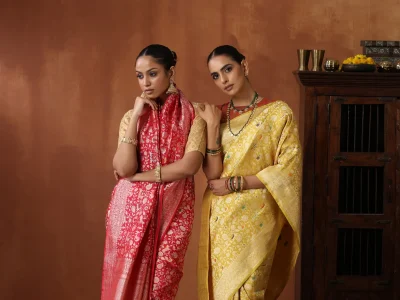
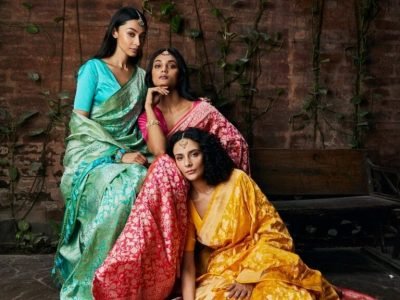
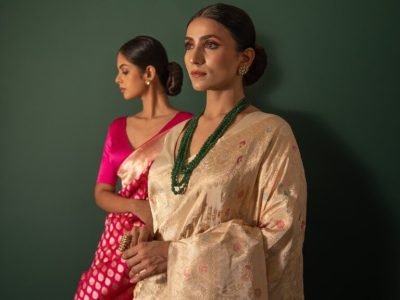
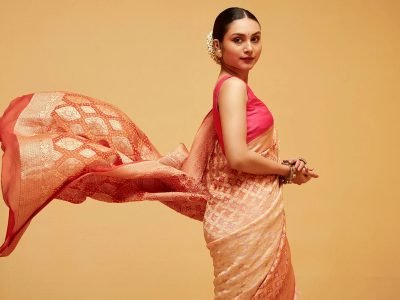
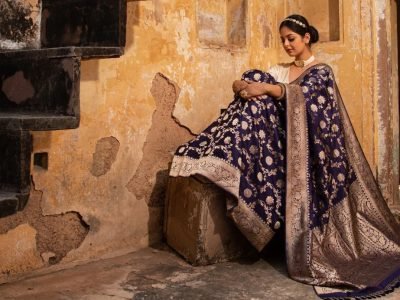
To drape a saree is to wrap oneself in the living history of a region. Every thread, every motif, every dye holds echoes of a place, its people, and the rhythms of their lives. India is not merely a country of languages and landscapes; it’s a mosaic of textile traditions. And nowhere is this more beautifully evident than in its sarees. From the northern valleys to the coastal plains, each region spins a narrative of its own—one that comes alive through fabric, technique, and design.
In the east, the crispness of Bengal cotton tells tales of rivers and rice fields, of morning rituals and quiet grace. The iconic white saree with red border—so simple in appearance—is layered with symbolism and emotion. It’s a saree worn by grandmothers during puja, by poets in corner cafés, by brides and widows alike, each drape adding a different voice to its legacy. Shantiniketan’s kantha embroidery, born from the instinct to repurpose and beautify, brings the hands of rural women into focus—stitching not just patterns, but dreams into the cloth. Jamdani, with its floating motifs woven painstakingly into muslin, is a whisper of elegance that once graced Mughal courts and now speaks to a global audience hungry for craftsmanship.
Travel west, and you encounter the luminous beauty of Bandhani. Dots, swirls, and waves appear on vibrant cloths through the art of tie-dye, each design passed down like family lore. The vibrancy of Gujarat and Rajasthan is palpable in these sarees—the riot of color mirroring the heat, the festivals, the spirit of a region that celebrates life with unmatched intensity. The mirror work and threadwork seen on blouses and borders don’t just embellish—they tell stories of tribal heritage and desert resilience. Meanwhile, the rich weaves of Patola, with their double ikat magic, represent a mathematical genius that few crafts can match. Precision here is not just art; it is devotion.
Move southward, and the tactile elegance of silk rises to meet you. In Tamil Nadu, the Kanjeevaram reigns supreme, a saree that feels as grand as a temple procession. Its heavy zari borders, temple motifs, and jewel tones speak of legacy and lineage, worn during life’s most sacred ceremonies. Each weave is a testament to the weaver’s meditative labor—a physical manifestation of divinity. In Karnataka, the understated beauty of Ilkal blends cotton and silk with grace, designed for everyday strength and village pride. The pallu, often dyed in deep red with a tope teni pattern, remains unique to its roots.
In Kerala, the ivory-and-gold Kasavu floats like a prayer. Worn during Onam and temple festivals, it holds within it the calm of the backwaters and the ancient rhythms of matrilineal society. It speaks softly but carries itself with immense dignity, a saree that never screams for attention but is always remembered. It is one of the few garments in India that transcends caste, occasion, and age—worn as easily by a child as by an elder.
The northeast, often under-celebrated in the larger saree narrative, offers fabrics that are both intricate and infused with identity. The Mekhela Chador of Assam, though not a saree in structure, shares the soul of draping tradition. It is woven with muga silk, unique in its golden glow, and decorated with motifs inspired by nature—peacocks, flowers, and rivers. These weaves carry the cadence of folk songs and the weight of ancestral knowledge. In Manipur, the Phanek, in Mizoram the Puan—all showcase how draping can be both a cultural practice and a declaration of belonging.
Maharashtra contributes the Paithani, a saree that carries the shimmer of peacock feathers and the grace of Maratha queens. Its borders glint with motifs drawn from Buddhist murals and temple sculptures. Each Paithani is a slow process, a labor of artistry that has been protected and preserved by families across generations. And from Odisha comes the Sambalpuri, where ikat breathes in deeper, earthier tones, and every motif—from conch shells to wheels—recalls the architecture and mythology of a land rooted in the past.
What makes regional sarees so powerful is not just their beauty, but their context. They are not designed in boardrooms or trend forecasts. They are born in looms inside homes, under verandahs, in villages with no billboards but centuries of knowledge. They carry within them the scent of soil, the silence of heritage, and the rhythm of real life. Wearing them is not just a style statement—it is a gesture of respect, a conversation with history, a preservation of identity.
In a world that often moves too fast, regional sarees ask us to slow down. To admire the way a motif curls like a vine, to understand why a particular red means marriage in one place and mourning in another, to see fabric not just as something to wear, but something to understand.
And perhaps that is the true magic of these sarees. They don’t just cover the body—they wrap you in stories. And in doing so, they keep alive the soul of a place, one thread at a time.